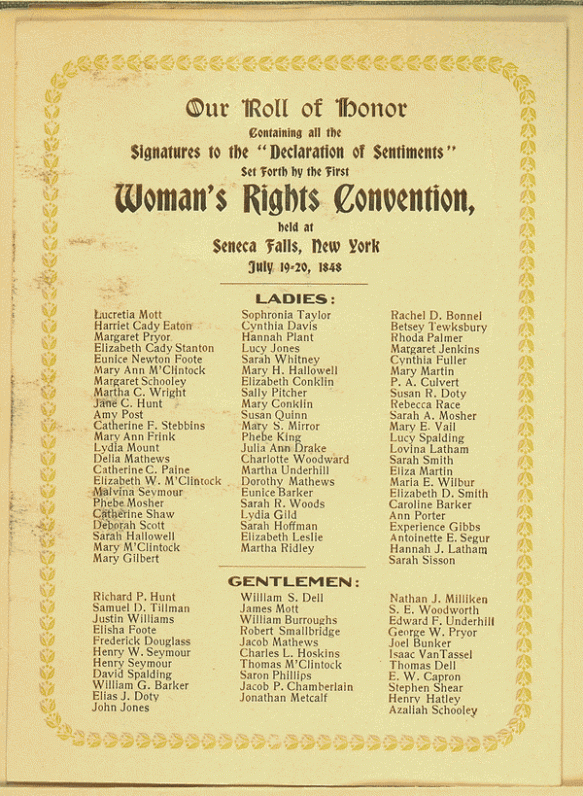
 Opening Lines of the Declaration:
“When, in the course of human events, it becomes necessary for one portion of the family of man to assume among the people of the earth a position different from that which they have hitherto occupied, but one to which the laws of nature and of nature’s God entitle them, a decent respect to the opinions of mankind requires that they should declare the causes that impel them to such a course. “
A few sentiments:
- He has never permitted her to exercise her inalienable right to the elective franchise.
- He has compelled her to submit to laws, in the formation of which she had no voice.
- He has withheld from her rights which are given to the most ignorant and degraded men – both natives and foreigners.
- Having deprived her of this first right as a citizen, the elective franchise, thereby leaving her without representation in the halls of legislation, he has oppressed her on all sides.
- He has made her, if married, in the eye of the law, civilly dead.
- He has taken from her all right in property, even to the wages she earns.
- He has endeavored, in every way that he could to destroy her confidence in her own powers, to lessen her self-respect, and to make her willing to lead a dependent and abject life.
The closing lines of the Declaration:
“ Now, in view of this entire disfranchisement of one-half the people of this country, their social and religious degradation—in view of the unjust laws above mentioned, and because women do feel themselves aggrieved, oppressed, and fraudulently deprived of their most sacred rights, we insist that they have immediate admission to all the rights and privileges which belong to them as citizens of these United States.
In entering upon the great work before us, we anticipate no small amount of misconception, misrepresentation, and ridicule; but we shall use every instrumentality within our power to effect our object. We shall employ agents, circulate tracts, petition the State and national Legislatures, and endeavor to enlist the pulpit and the press in our behalf. We hope this Convention will be followed by a series of Conventions, embracing every part of the country.
Click to read the entire Declaration of Sentiments at Wikipedia.
I’m Barbara Talley, the poet who speaks and inspires. To find out more about me check out: What Does Barbara Do? or visit my website.

 We are a nation of laws and yet those laws and noble sentiments do not guarantee that everyone is given the same equal opportunities, protection, or justice under the law. I once heard that we should not judge a country by how many wealthy people it has, but by how many poor it has. On that same note, we should not judge a country by how many freedoms they have on the books, but instead by how many people are still not allowed to enjoy those basic freedoms. We should not judge a country by how many Nobel Laureates or Rhodes Scholars they have but by how many children they allow to go uneducated, unemployed, exploited, abused, or incarcerated because of the lack of education, protection, and nurturing. Continue to part 2.

 Welcome to Barbara’s Site