The Science of Creating Your Own Luck

Are you lucky?  Is there a science to luck or is it a spiritual blessing or divine grace?   I am one of those right brain people whose pendulum swings way to the right when given a choice to rely on science or spirit. I tend to look first towards spirituality to explain or guide me with work, relationships, and setting goals.  I also look for the spiritual lesson when I encounter adversity.  So, looking for a scientific explanation of why things are is not my first line of defense.  But, I’m consistently learning that science compliments spirituality and explains things logically.  With spirituality, I don’t have to know why; I just know what is.  But, science explains the why and I am even more confirmed.  For example, I know from experience that prayer and meditation work.  Science attempts to explain why.    But, I’m learning that it is not an either/or choice.  Both are valuable and both play a role.

4 Steps to Create Your Own Luck

Many people would consider me lucky.  I am if the definition is: “Luck is where opportunity meets preparedness.”  Yes I am lucky but I feel that my attitude and faith create my luck.  Richard Wiseman studies luck and has actually come up with a prescription for how it’s done.  You’ll want to read his insightful article, Be Lucky- it’s an easy skill to learn. He writes,  “My research revealed that lucky people generate good fortune via four basic principles.They are:

  1. Skilled at creating and noticing chance opportunities,
  2. Make lucky decisions by listening to their intuition,
  3. Create self-fulfilling prophesies via positive expectations, and
  4. Adopt a resilient attitude that transforms bad luck into good.”

After graduating from his luck school, 80% of his students were luckier.  Scientific or spiritual luck?  Perhaps you don’t have to choose and can have both!  I’m  going to make sure I apply the principles above and for luck, I’m going to continue to pray.  There you have it.  Feeling luckier?

I’m Barbara Talley, the poet who speaks and inspires.  To find out more about me check out: What Does Barbara Do? or visit  my website.

Study: 80 Percent of College Admissions Departments Stalk Your Facebook – TIME NewsFeed

Did you know that 82% of college admissions officers use Facebook in their recruiting?  What image have you portrayed on your social media sites?  Is it one that seals the deal and gets you that letter?  Many high school seniors are anxiously awaiting to hear what colleges they will be attending.  Some are just beginning to apply.  I hope for your sake that you have not put anything on Face-book that paints you in an unfavorable light.  For all of you middle school and high schoolers, be careful what you put out on the social media sites.  It could come back to haunt you.  And college students and everyone else must also be careful of the image they portray on social media sites.  You’ll be looking for jobs one day.  Remember info in the webisphere can hang out there forever. Consider the following:

“We all know that employers check out your online persona, but the trend is spreading. Now your dirty laundry on the Internet could keep you out of college, too.

A new survey from Kaplan Test Prep reveals that 82 percent of admissions officers use Facebook in their recruiting. While this sounds like a positive spin on having an online presence – meaning the college of your dreams can see your interests and your favorite books. And maybe yours jive perfectly with that of the college’s dream student.”  Click below to continue article.

via Study: 80 Percent of College Admissions Departments Stalk Your Facebook – TIME NewsFeed.

Why Do We Have So Many Negative Thoughts?

Every thought and emotion has its own energetic signature or wave frequencyToeTalkwithTina writes: “Even our thoughts and emotions are energy, and every specific thought has its own unique vibrational frequency. Anger has its own frequency. Depression has its own frequency. Jealousy has its own frequency, etc, etc. Remember…energy MUST move. So when we choose to stifle a negative thought or emotion, and just keep tucking away all those hurt feelings, it is the equivalent of a percolating volcano. Eventually something is going to move….or BLOW!”

Your Assignment

If you believe that what you focus on magnifies in our lives, then you need to make a conscious effort to use and focus on those words that enhance your life .  Here’s  your assignment:  For the next week eavesdrop on your thoughts, words, and your conversations.  How many of your words, conversations, and interactions were positive?

Research shows that we are far more negative words in our vocabulary than positive ones.  Robert Schrauf, associate professor of applied linguistics and an anthropologist at Penn State was quoted in an ABC News on-line article titled, “Study: Negative Words Dominate Language’. ” Schraf says he was a bit puzzled when he began analyzing data he collected that shows that regardless of age or culture, we have far more words in our vocabulary that express negative rather than positive emotions.  …I found this surprising result,” Schrauf says. “Half of all the words that people produce from their working vocabulary to express emotion are negative. And 30 percent are positive and 20 percent are neutral.”

He has an idea of why this is so,”Negative emotions require more detailed thinking, more subtle distinctions,” says Schrauf, whose research was published in a recent issue of the Journal of Multilingual and Multicultural Development. So we conjure up more negative words because the language needs to be precise. And this research suggests that’s probably true for every culture and every age group. Even though some of the words may not have precisely the same meaning in every language, they tend to be more negative than positive.”

Until next time…

I’m Barbara Talley, the poet who speaks and inspires.  To find out more about me check out: What Does Barbara Do? or visit  my website.

The Power of Words

Words are the building blocks of our communication with ourselves and others.  It is the means by which we exchange ideas, thoughts, desires, fears, needs, beliefs, etc. Negative words produce negative emotions.  Positive words produce positive emotions.  Let’s test it.  Think about debt, clutter, weight, divorce, death, bankruptcy, hatred, or betrayal.  How are you feeling?  Now think about abundance, order, beauty, freedom, fitness, health, vitality, faithfulness, and love. Do these words make you feel different? The challenge then is to use more positive words in our conversations, thoughts, and communications.  The words we use have programmed us and as we use new words we are changing the program.

Words also have ‘staying power’ both the negative and the positive.

Be careful what you put out into the universe because words have staying power.  Once implanted in someones heart or mind, they can grow there forever.  Everyone can recall without much effort a time in their lives when they were hurt by words.  For me, it was being called, “Fish Girl.” My dad had a fish market in Pennsylvania when I was between the ages of seven and twelve.  He would load up fish and produce in the truck and go door to door yelling, “Fresh Fish, Fresh Greens, Fresh Produce.”  Come and get your “Fresh Fish, Fresh Greens, Fresh Produce.”  On the surface it shouldn’t evoke painful memories, but it does.  You see when we weren’t out selling the fish, we were preparing the fish.  We couldn’t go out and play, have friends over, or have a normal childhood.  Most of our time was spent cleaning, scraping, and gutting hundreds of pounds of fish weekly.  The fish came in fifty pound boxes and my sisters and I had to stay up many nights getting the fish ready for sale the next day.  Our hands were cold and frozen and sore from being stuck and pricked by the fish fins.  If this weren’t enough, the kids would mock us to and from school.  They would throw things and us and call us “Fish Girls.”  Laughing at us saying that we smelled like fish.  Yes words can hurt, but words also can heal.  Unfortunately,  children learn the bad from their environment.  Realize that you are now a teacher and a role model for the children.  And, “If you can’t say something nice, don’t say anything.”

I’m Barbara Talley, the poet who speaks and inspires.  To find out more about me check out: What Does Barbara Do? or visit  my website.
Equal Rights Amendment Facts

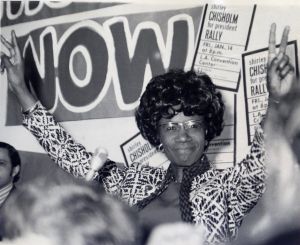
This is Women’s History Month.  So yesterday I challenged you to see how much you knew about the Equal Rights Amendment. I posed twelve questions to you.  How did you do?  I will present the answers below, but before I do, have you wondered why we even need an Equal Rights Amendment?  Shirley Chisholm shown here (another Women’s History figure to learn about) is championing the Equal Rights Amendment.

Those fighting for the ERA say that women and blacks were not included in the Constitution.  Rights were for land owning white men.  That is why an Amendment had to be passed giving black men the right to vote.  Then the 19th Amendment had to be passed giving women the right to vote and amending the Constitution.

“The need for the ERA can be expressed simply as a warning. Unless we put into the Constitution the bedrock principle that equality of rights cannot be denied or abridged on account of sex, the political and judicial victories women have achieved with their blood, sweat, and tears for the past two centuries are vulnerable to erosion or reversal at any time – now or in the future.  Congress has the power to make laws that replace existing laws – and to do so by a simple majority. Therefore, many of the current legal protections against sex discrimination can be removed by the margin of a single vote.” EqualRightsAmendment.org

The Answers Appear Below are from Equal Rights Amendment.org too.
  1. What is the Equal Rights Amendment?
    Equality of rights under the law shall not be denied or abridged by the United States or by any state on account of sex.
    The Equal Rights Amendment would provide a fundamental legal remedy against sex discrimination for both women and men. It would guarantee that the rights affirmed by the U.S. Constitution are held equally by all citizens without regard to sex.
  2. Who wrote the text for it?
    The Equal Rights Amendment was written in 1923 by Alice Paul, a leader of the woman suffrage movement and a lawyer.
  3. When was it first introduced to Congress?
    It was introduced in Congress in 1923 and subsequently reintroduced in every Congressional session for half a century.
  4. How many years did it take to pass?
    It took 49 years to pass in the Congress.  On March 22, 1972, the ERA finally passed the Senate and the House of Representatives by the required two-thirds majority.
  5. What year was it sent to the States for ratification?
    On March 22, 1972, it was sent to the states for ratification.
  6. How many States are needed to ratify the Amendment?
    Three/fourths of the States or 35 States were  necessary to ratify the Amendment.
  7. How many years did Congress allow for the States to ratify the Amendment?
    An original seven-year deadline was later extended by Congress to June 30, 1982.
  8. Did enough States ratify the Amendment before the time limit expired?
    NO!
  9. What happened then?
    It is therefore not yet included in the U.S. Constitution.
  10. How many States actually ratified the Amendment?
    When this deadline expired, only 35 of the necessary 38 states (the constitutionally required three-fourths) had ratified the ERA.
  11. Is it ratified now?
    NO! The Equal Rights Amendment has been reintroduced in every session of Congress since 1982.
  12. Which States didn’t ratify the Amendment?
    The 15 states whose legislatures have not ratified the Equal Rights Amendment are Alabama, Arizona, Arkansas, Florida, Georgia, Illinois, Louisiana, Mississippi, Missouri, Nevada, North Carolina, Oklahoma, South Carolina, Utah, and Virginia.

So, what did you learn and what do you think about this?

I’m Barbara Talley, the poet who speaks and inspires.  To find out more about me check out: What Does Barbara Do? or visit  my website.