Study: 80 Percent of College Admissions Departments Stalk Your Facebook – TIME NewsFeed

Did you know that 82% of college admissions officers use Facebook in their recruiting?  What image have you portrayed on your social media sites?  Is it one that seals the deal and gets you that letter?  Many high school seniors are anxiously awaiting to hear what colleges they will be attending.  Some are just beginning to apply.  I hope for your sake that you have not put anything on Face-book that paints you in an unfavorable light.  For all of you middle school and high schoolers, be careful what you put out on the social media sites.  It could come back to haunt you.  And college students and everyone else must also be careful of the image they portray on social media sites.  You’ll be looking for jobs one day.  Remember info in the webisphere can hang out there forever. Consider the following:

“We all know that employers check out your online persona, but the trend is spreading. Now your dirty laundry on the Internet could keep you out of college, too.

A new survey from Kaplan Test Prep reveals that 82 percent of admissions officers use Facebook in their recruiting. While this sounds like a positive spin on having an online presence – meaning the college of your dreams can see your interests and your favorite books. And maybe yours jive perfectly with that of the college’s dream student.”  Click below to continue article.

via Study: 80 Percent of College Admissions Departments Stalk Your Facebook – TIME NewsFeed.
The Power of Words

Words are the building blocks of our communication with ourselves and others.  It is the means by which we exchange ideas, thoughts, desires, fears, needs, beliefs, etc. Negative words produce negative emotions.  Positive words produce positive emotions.  Let’s test it.  Think about debt, clutter, weight, divorce, death, bankruptcy, hatred, or betrayal.  How are you feeling?  Now think about abundance, order, beauty, freedom, fitness, health, vitality, faithfulness, and love. Do these words make you feel different? The challenge then is to use more positive words in our conversations, thoughts, and communications.  The words we use have programmed us and as we use new words we are changing the program.

Words also have ‘staying power’ both the negative and the positive.

Be careful what you put out into the universe because words have staying power.  Once implanted in someones heart or mind, they can grow there forever.  Everyone can recall without much effort a time in their lives when they were hurt by words.  For me, it was being called, “Fish Girl.” My dad had a fish market in Pennsylvania when I was between the ages of seven and twelve.  He would load up fish and produce in the truck and go door to door yelling, “Fresh Fish, Fresh Greens, Fresh Produce.”  Come and get your “Fresh Fish, Fresh Greens, Fresh Produce.”  On the surface it shouldn’t evoke painful memories, but it does.  You see when we weren’t out selling the fish, we were preparing the fish.  We couldn’t go out and play, have friends over, or have a normal childhood.  Most of our time was spent cleaning, scraping, and gutting hundreds of pounds of fish weekly.  The fish came in fifty pound boxes and my sisters and I had to stay up many nights getting the fish ready for sale the next day.  Our hands were cold and frozen and sore from being stuck and pricked by the fish fins.  If this weren’t enough, the kids would mock us to and from school.  They would throw things and us and call us “Fish Girls.”  Laughing at us saying that we smelled like fish.  Yes words can hurt, but words also can heal.  Unfortunately,  children learn the bad from their environment.  Realize that you are now a teacher and a role model for the children.  And, “If you can’t say something nice, don’t say anything.”

I’m Barbara Talley, the poet who speaks and inspires.  To find out more about me check out: What Does Barbara Do? or visit  my website.

Great Self-Help Resource on Brain Research

Have you ever clicked on one of those sites that completely sucked you in because of the overwhelming amount of value?  I don’t even know how I happened upon this self-help site on brain research, but everything in it resonated with what I was already learning and studying.  I couldn’t believe it.  I simply loved it and I hope you will too.  Here is a little excerpt to wet your whistle.  It sure captured my attention!

“I help you reverse engineer your mind (so to speak) to learn how your brain functions; your limiting beliefs about money, relationships and health; and the cause of your lack of success. To effectively make permanent changes and eliminate this self-sabotage, you need to understand how these non-conscious blocks (internal conflicts) were created in the first place.  When you strive for self-improvement in anything and it just isn’t happening, realize there are two very good reasons for this.

1. You have been programmed with self-limiting beliefs that stop you.

2. Your ancestral DNA is actually working without your awareness to keep you safe with what is already familiar and comfortable.  Some refer to this as “psychological reversal” while others might call it “self-sabotage”. via Brain research – self help. Go on; click on the link and learn more!

I’m Barbara Talley, the poet who speaks and inspires.  To find out more about me check out: What Does Barbara Do? or visit  my website.

Equal Rights Amendment Facts

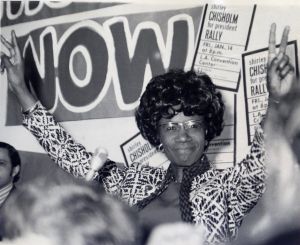
This is Women’s History Month.  So yesterday I challenged you to see how much you knew about the Equal Rights Amendment. I posed twelve questions to you.  How did you do?  I will present the answers below, but before I do, have you wondered why we even need an Equal Rights Amendment?  Shirley Chisholm shown here (another Women’s History figure to learn about) is championing the Equal Rights Amendment.

Those fighting for the ERA say that women and blacks were not included in the Constitution.  Rights were for land owning white men.  That is why an Amendment had to be passed giving black men the right to vote.  Then the 19th Amendment had to be passed giving women the right to vote and amending the Constitution.

“The need for the ERA can be expressed simply as a warning. Unless we put into the Constitution the bedrock principle that equality of rights cannot be denied or abridged on account of sex, the political and judicial victories women have achieved with their blood, sweat, and tears for the past two centuries are vulnerable to erosion or reversal at any time – now or in the future.  Congress has the power to make laws that replace existing laws – and to do so by a simple majority. Therefore, many of the current legal protections against sex discrimination can be removed by the margin of a single vote.” EqualRightsAmendment.org

The Answers Appear Below are from Equal Rights Amendment.org too.
  1. What is the Equal Rights Amendment?
    Equality of rights under the law shall not be denied or abridged by the United States or by any state on account of sex.
    The Equal Rights Amendment would provide a fundamental legal remedy against sex discrimination for both women and men. It would guarantee that the rights affirmed by the U.S. Constitution are held equally by all citizens without regard to sex.
  2. Who wrote the text for it?
    The Equal Rights Amendment was written in 1923 by Alice Paul, a leader of the woman suffrage movement and a lawyer.
  3. When was it first introduced to Congress?
    It was introduced in Congress in 1923 and subsequently reintroduced in every Congressional session for half a century.
  4. How many years did it take to pass?
    It took 49 years to pass in the Congress.  On March 22, 1972, the ERA finally passed the Senate and the House of Representatives by the required two-thirds majority.
  5. What year was it sent to the States for ratification?
    On March 22, 1972, it was sent to the states for ratification.
  6. How many States are needed to ratify the Amendment?
    Three/fourths of the States or 35 States were  necessary to ratify the Amendment.
  7. How many years did Congress allow for the States to ratify the Amendment?
    An original seven-year deadline was later extended by Congress to June 30, 1982.
  8. Did enough States ratify the Amendment before the time limit expired?
    NO!
  9. What happened then?
    It is therefore not yet included in the U.S. Constitution.
  10. How many States actually ratified the Amendment?
    When this deadline expired, only 35 of the necessary 38 states (the constitutionally required three-fourths) had ratified the ERA.
  11. Is it ratified now?
    NO! The Equal Rights Amendment has been reintroduced in every session of Congress since 1982.
  12. Which States didn’t ratify the Amendment?
    The 15 states whose legislatures have not ratified the Equal Rights Amendment are Alabama, Arizona, Arkansas, Florida, Georgia, Illinois, Louisiana, Mississippi, Missouri, Nevada, North Carolina, Oklahoma, South Carolina, Utah, and Virginia.

So, what did you learn and what do you think about this?

I’m Barbara Talley, the poet who speaks and inspires.  To find out more about me check out: What Does Barbara Do? or visit  my website.

Women’s History Month- What Do Your Know about the Equal Rights Amendment?

This is Women’s History Month and I for one am revisiting my history. Frankly I was a little surprised and perhaps a little embarrassed at how little I knew or remembered.  So in the spirit of educating my sisters (and brothers) I have put together a little quiz.

How much do you know about the work and the women that are fighting and have been fighting to guarantee equal rights under the constitution for women?

There are those that say it is not necessary.  But view the ERA response:

“Would anyone really want to turn back the clock on women’s advancement? Ask the members of Congress who have tried to cripple Title IX, which requires equal opportunity in education – who have opposed the Violence Against Women Act, the Fair Pensions Act, and the Paycheck Fairness Act – who voted to pay for Viagra for servicemen but oppose funding for family planning and contraception – who for decades have blocked U.S. ratification of the United Nations Convention on the Elimination of All Forms of Discrimination Against Women (CEDAW).”

Test Your Knowledge

  1. What is the Equal Rights Amendment?
  2. Who wrote the text for it?
  3. When was it first introduced to Congress?
  4. How many years did it take to pass?
  5. What year was it sent to the States for ratification?
  6. How many States are needed to ratify the Amendment?
  7. How many years did Congress allow for the States to ratify the Amendment?
  8. Did enough States ratify the Amendment before the time limit expired?
  9. What happened then?
  10. How many States actually ratified the Amendment?
  11. Is it ratified now?
  12. Which States didn’t ratify the Amendment?

Find the answers yourself, or continue article to view answers.