Are You On Purpose?

“Until thought is linked with purpose there is no intelligent accomplishment,” wrote James Allen, author of ‘As a Man Thinketh.’  There have been times in my life that my excitement and energy were so pronounced that people have asked, “What are you on?”  I’d respond with, “I’m on purpose!” At those times I was undoubtedly thinking about things that excited me, motivated me, and uplifted me. My vision and perspectives were uplifting and clearly I was thinking about meaningful things, purposeful things, or things that brought me or someone else joy.   At those times, I tended to have absolute hope in the future, faith in people, and understood that divine grace was guiding and protecting me.

Elevate Your Thoughts and Elevate Your Reality

Eleanor Roosevelt wrote: “Great minds discuss ideas. Average minds discuss events. Small minds discuss people.”  I can say for sure when my energy, vision, and excitement are high that I am most certainly NOT thinking about events or gossiping or complaining about people.  When my thinking was skewed, I’d fear the future, distrust people and their intentions, and feel all alone and hopeless in my doldrums.  But when my thinking is right, that faithful feeling of knowing and of being connected sparks my creativity and solutions to whatever problems I have become clear.  The right person, thought, idea, or circumstances seem to appear before me.  I’ve learned that if I listen to my guidance and act immediately, that solving whatever problem is before me becomes an exciting journey rather than anxiety driven mission.  Even more importantly the “problems” are no longer debilitating but instead become opportunities for growth.  Just changing my perspective changed my focus and changing my focus changed my reality.   You are the driver and your thoughts can take you anywhere, so be careful and stay alert.

I’m Barbara Talley, the poet who speaks and inspires.  To find out more about me check out: What Does Barbara Do? or visit  my website.
The Power of Words

Words are the building blocks of our communication with ourselves and others.  It is the means by which we exchange ideas, thoughts, desires, fears, needs, beliefs, etc. Negative words produce negative emotions.  Positive words produce positive emotions.  Let’s test it.  Think about debt, clutter, weight, divorce, death, bankruptcy, hatred, or betrayal.  How are you feeling?  Now think about abundance, order, beauty, freedom, fitness, health, vitality, faithfulness, and love. Do these words make you feel different? The challenge then is to use more positive words in our conversations, thoughts, and communications.  The words we use have programmed us and as we use new words we are changing the program.

Words also have ‘staying power’ both the negative and the positive.

Be careful what you put out into the universe because words have staying power.  Once implanted in someones heart or mind, they can grow there forever.  Everyone can recall without much effort a time in their lives when they were hurt by words.  For me, it was being called, “Fish Girl.” My dad had a fish market in Pennsylvania when I was between the ages of seven and twelve.  He would load up fish and produce in the truck and go door to door yelling, “Fresh Fish, Fresh Greens, Fresh Produce.”  Come and get your “Fresh Fish, Fresh Greens, Fresh Produce.”  On the surface it shouldn’t evoke painful memories, but it does.  You see when we weren’t out selling the fish, we were preparing the fish.  We couldn’t go out and play, have friends over, or have a normal childhood.  Most of our time was spent cleaning, scraping, and gutting hundreds of pounds of fish weekly.  The fish came in fifty pound boxes and my sisters and I had to stay up many nights getting the fish ready for sale the next day.  Our hands were cold and frozen and sore from being stuck and pricked by the fish fins.  If this weren’t enough, the kids would mock us to and from school.  They would throw things and us and call us “Fish Girls.”  Laughing at us saying that we smelled like fish.  Yes words can hurt, but words also can heal.  Unfortunately,  children learn the bad from their environment.  Realize that you are now a teacher and a role model for the children.  And, “If you can’t say something nice, don’t say anything.”

I’m Barbara Talley, the poet who speaks and inspires.  To find out more about me check out: What Does Barbara Do? or visit  my website.
Equal Rights Amendment Facts

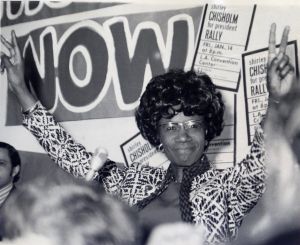
This is Women’s History Month.  So yesterday I challenged you to see how much you knew about the Equal Rights Amendment. I posed twelve questions to you.  How did you do?  I will present the answers below, but before I do, have you wondered why we even need an Equal Rights Amendment?  Shirley Chisholm shown here (another Women’s History figure to learn about) is championing the Equal Rights Amendment.

Those fighting for the ERA say that women and blacks were not included in the Constitution.  Rights were for land owning white men.  That is why an Amendment had to be passed giving black men the right to vote.  Then the 19th Amendment had to be passed giving women the right to vote and amending the Constitution.

“The need for the ERA can be expressed simply as a warning. Unless we put into the Constitution the bedrock principle that equality of rights cannot be denied or abridged on account of sex, the political and judicial victories women have achieved with their blood, sweat, and tears for the past two centuries are vulnerable to erosion or reversal at any time – now or in the future.  Congress has the power to make laws that replace existing laws – and to do so by a simple majority. Therefore, many of the current legal protections against sex discrimination can be removed by the margin of a single vote.” EqualRightsAmendment.org

The Answers Appear Below are from Equal Rights Amendment.org too.
  1. What is the Equal Rights Amendment?
    Equality of rights under the law shall not be denied or abridged by the United States or by any state on account of sex.
    The Equal Rights Amendment would provide a fundamental legal remedy against sex discrimination for both women and men. It would guarantee that the rights affirmed by the U.S. Constitution are held equally by all citizens without regard to sex.
  2. Who wrote the text for it?
    The Equal Rights Amendment was written in 1923 by Alice Paul, a leader of the woman suffrage movement and a lawyer.
  3. When was it first introduced to Congress?
    It was introduced in Congress in 1923 and subsequently reintroduced in every Congressional session for half a century.
  4. How many years did it take to pass?
    It took 49 years to pass in the Congress.  On March 22, 1972, the ERA finally passed the Senate and the House of Representatives by the required two-thirds majority.
  5. What year was it sent to the States for ratification?
    On March 22, 1972, it was sent to the states for ratification.
  6. How many States are needed to ratify the Amendment?
    Three/fourths of the States or 35 States were  necessary to ratify the Amendment.
  7. How many years did Congress allow for the States to ratify the Amendment?
    An original seven-year deadline was later extended by Congress to June 30, 1982.
  8. Did enough States ratify the Amendment before the time limit expired?
    NO!
  9. What happened then?
    It is therefore not yet included in the U.S. Constitution.
  10. How many States actually ratified the Amendment?
    When this deadline expired, only 35 of the necessary 38 states (the constitutionally required three-fourths) had ratified the ERA.
  11. Is it ratified now?
    NO! The Equal Rights Amendment has been reintroduced in every session of Congress since 1982.
  12. Which States didn’t ratify the Amendment?
    The 15 states whose legislatures have not ratified the Equal Rights Amendment are Alabama, Arizona, Arkansas, Florida, Georgia, Illinois, Louisiana, Mississippi, Missouri, Nevada, North Carolina, Oklahoma, South Carolina, Utah, and Virginia.

So, what did you learn and what do you think about this?

I’m Barbara Talley, the poet who speaks and inspires.  To find out more about me check out: What Does Barbara Do? or visit  my website.

Dream Derailer #9g- Insufficient Education (continued)

Can you imagine telling your parents you’re dropping out of Harvard to start a company?  That’s what Bill Gates did.  He had that much faith in his dream.  Andrew Jackson was a Congressman and President of the United States and never attended college.  Rachel Ray got her start teaching cooking classes even though she never went to culinary school.  She also has her own magazine and is a best-selling author.  John D. Rockefeller Sr. started Standard Oil and became the richest man in history with no college degree.  How many people reading this have allowed the fact that they don’t have a degree in a particular area to stop them from pursuing their dreams?  And, what if you wanted to be a movie producer but were denied access to film school, would that stop you?  It didn’t stop Steven Spielberg.

If You Need An Excuse, Any One Will Do!

Some people would allow the lack of money or age to keep them from going after their dreams, not  Mark Zuckerberg.  He had to borrow money to start Face-book and went on to become the youngest person to appear on the Forbes billionaire list.  And, Henry Ford never even graduated from High School.  That didn’t stop him from starting the Ford Automotive company.  Think of how many people were able to be employed and how his automating the car production process has changed our world.  One of his keys to success was that he surrounded himself with knowledgeable people.  Perhaps you should to.  Source- 10 Famous People Who Didn’t Go to College. What these extraordinary people show us is that if you have the talent, you can make it!  They followed their bliss.

I’m Barbara Talley, the poet who speaks and inspires.  To find out more about me check out: What Does Barbara Do? or visit  my website.

Dream Derailer #9b: Insufficient Resources (Money)

“The amount of money we earn is a reflection of what we feel we are worth.” This is just one of the profound statements that Margaret Lynch, author of ‘The Secret of Intentional Wealth, spoke about during the 2011 World Tapping Summit.  She explained that our outer reality reflects our inner state.  She encouraged listeners to examine  their silent and verbal conversations about money and the danger of constantly saying, “I can’t afford that?”

What Are Your Beliefs and Language Regarding Money?

Carol Tuttle, (another EFT practitioner on wealth) asserted that we have lost contact with money.  We don’t see it since most transactions are done electronically, and therefore we create more debt.  Debt is a blockage of the abundance.  Tapping helps to remove the blocks and the natural abundance flows to us.   She believes that, we sabotage or block our success because of our beliefs around money. We either don’t believe we deserve it, think that wealth is worldly or unspiritual, or perhaps don’t feel we deserve success because of some past indiscretion, action, or self-betrayal.  The language we speak either attracts money to us or keeps it beyond our reach.  Do we secretly resent people who have money?  Do we think rich people are crooks?  Are we jealous when someone else gets something that we don’t have?  These are just a few of the questions she recommends we answer to remove any blockages we have about attracting money.

I’m Barbara Talley, the poet who speaks and inspires.  To find out more about me check out: What Does Barbara Do? or visit  my website.